
The History


Abbadia Ardenga
The History of Abbadia Ardenga
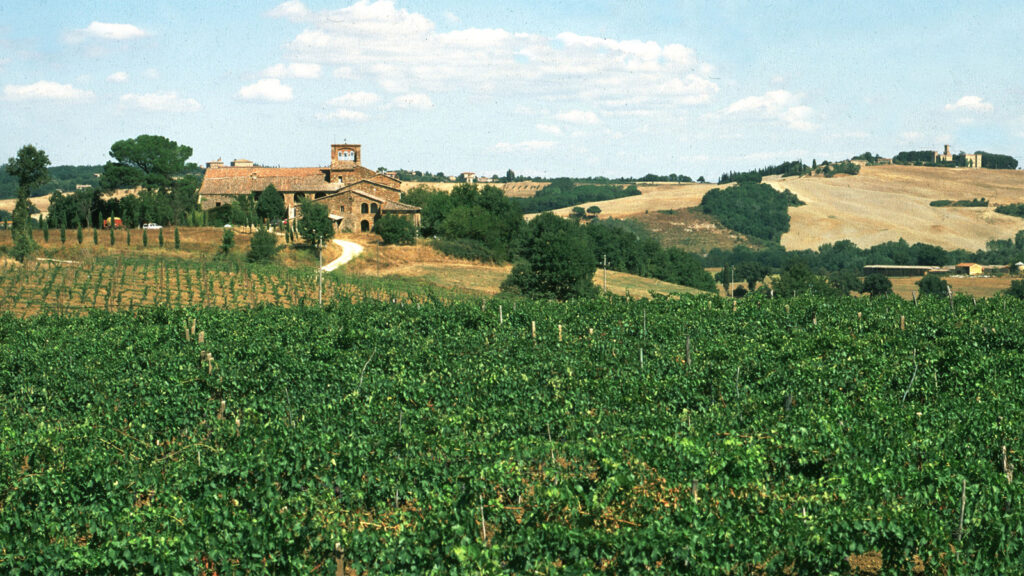
The history of Abbadia Ardenga is ancient and eventful, with roots stretching back to the depths of the Middle Ages when, in the 11th century, the Ardenga Monastery was founded by a French-born count from the Ranieri family. Part of the Monastery was destroyed, sharing the sad fate of many locations in the Sienese countryside during those harsh medieval times.
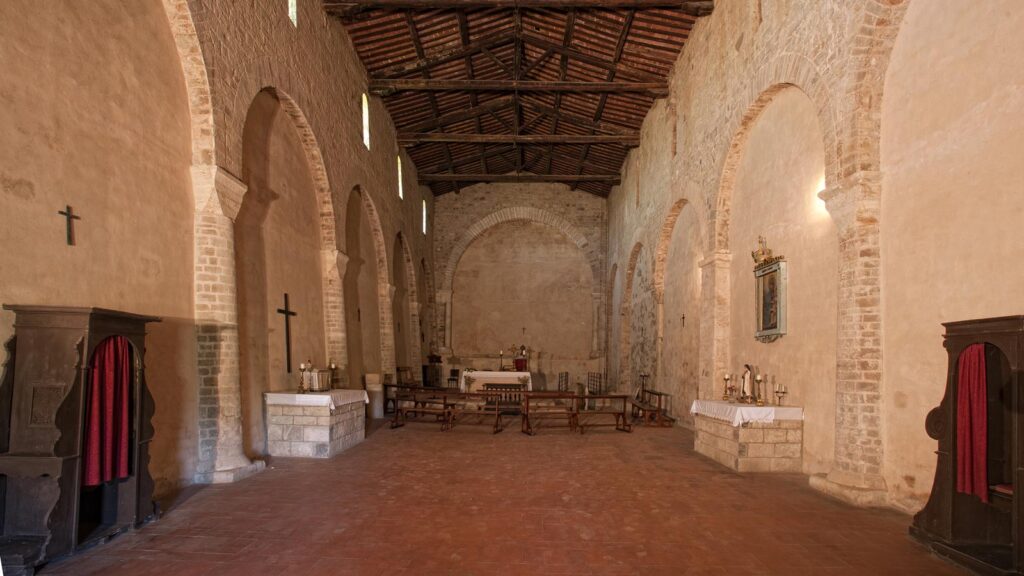
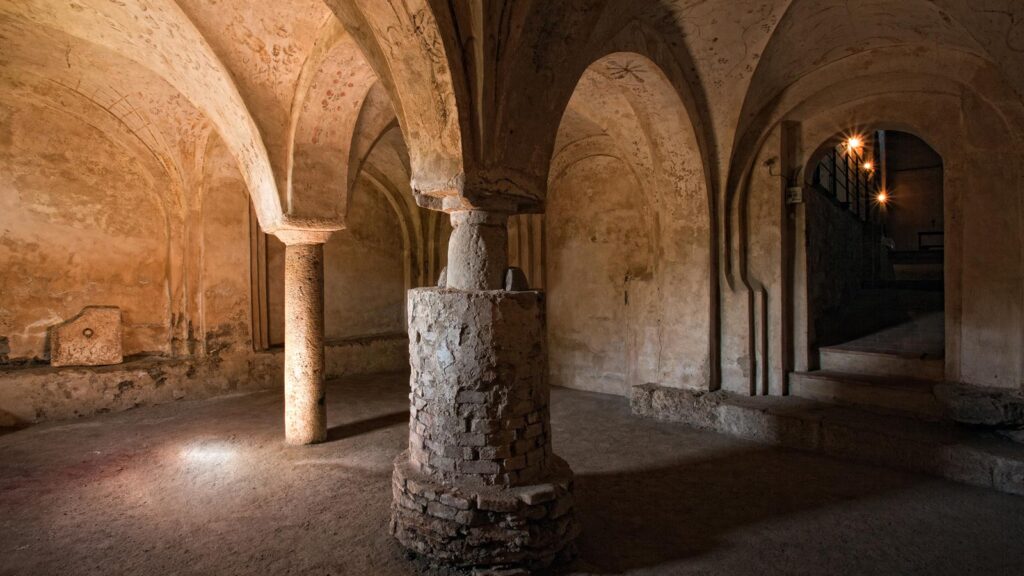
Within the Romanesque Church of St. Andrew in Abbadia Ardenga, some architectural elements from that era have been discovered, but the most important and striking find is more than two-thirds of an ancient crypt. It is a crypt with seven naves, two of which span the entire width of the church.
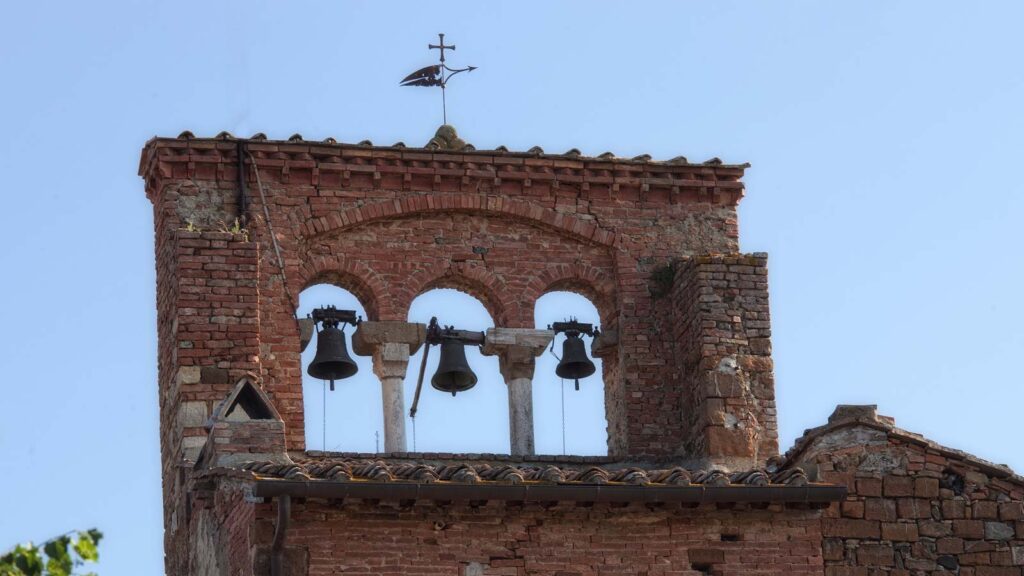
In the vaults, there is a decoration consisting of ancient floral pictorial motifs—possibly the only examples in the entire Sienese region. The 14th-century bell gable (campanile a vela) is particularly noteworthy. The columns, which lean outward from the church, catch the eye as soon as one steps through the doorway. Even older elements can be seen in the corbels depicting animal heads, adorning the simple travertine portal, as well as those supporting the coat of arms on the church’s facade.
Items originating from Abbadia Ardenga and now kept at the Pinacoteca of Siena include the Romanesque Paliotto—the earliest dated painting of the Sienese school (1215)—and the panels depicting the Stories of the Passion of Christ, attributed to Giudo da Siena (1275–1280).
The abbey
The abbey was suppressed in 1464 by Pope Pius II, for reasons still unknown, through the issuance of a papal bull while he was in Petriolo seeking treatment in the famous thermal waters.
Legend has it that the monks of that time, before Pope Pius II could seize their possessions, hid a bell made entirely of gold.
Its assets were divided into three parts: one was assigned to the new Abbadia Ardenga and granted in commendam to the Tuti family of Siena; the other two were allocated respectively to the construction of the Montalcino cathedral and to the funding of a crusade. The Tuti family maintained power until the 17th century, and the last remembered figure was Abbot Fulvio Tuti. Once the Tuti line died out, the abbey passed to the Marsili family and then, in the early decades of the 18th century, to Cardinal Patrizi. In 1783, Grand Duke Leopold I transferred all remaining assets and jurisdiction over the abbey and its territories to the Diocese of Montalcino; later, it was placed under the Diocese of Siena, becoming a parish.
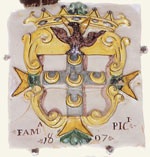
At the beginning of the 1800s, the Piccolomini family began selling packaged wine and oil to travelers who stopped at the “post station.”
This ceramic piece marks the property and is still embedded at the entrance to the winery.
Abbadia Ardenga
The Origins
The premises that today make up the Abbadia Ardenga winery date back to the Etruscan-Roman period and were located at the crossroads of major trade routes. One of the earliest watchtowers for lookout and defense was built here.
Merchants traveling between the Etruscan cities of Chiusi, Roselle, Arezzo, and Volterra passed through this area. The stone constructions date back to prehistoric times, mainly because there were abundant water springs. These springs were extremely important but also the cause of many disputes.
The “Torre Nera” (Black Tower), so-called because of the color of its stone, dominated a long stretch of road toward both Rome and Siena. It effectively marked the boundary between the Asso Valley and the Arbia Valley. In the year 990, the Archbishop of Canterbury (Sigeric) stayed here while returning from Rome to London. Henry VII of Luxembourg, King of Germany and Emperor of the Holy Roman Empire, also stopped in this area, where he suddenly died.
In 1315, an Italo-German army set out from Pisa and came directly to this castle. They attacked and destroyed it. The soldiers then looted, killed, and raped, finally setting fire to all the surrounding houses. They claimed to be avenging the death of their Emperor, whom they believed had been poisoned here. After several decades marked by further battles and serious epidemics, the castle was rebuilt.
The area soon experienced significant growth. Along the road leading to Rome, houses, shops, a hospice, a church, and even another castle were built to protect the mills and the businesses that had developed along the Asso River. The settlement grew into an independent municipality under the jurisdiction of the Republic of Siena, ultimately taking the name Torrenieri.
The Torre Nera castle, owned by the Piccolomini family, became a roadside stop. Stables, a hospice, and a tavern were constructed, and it was renamed the “Stazione di Posta del Poggio di Torrenieri,” while still retaining the appearance of an old fortress.
The Sienese historian Giovanni Antonio Pecci, writing around 1700, described it as follows:
> “On the road from Siena to Rome,
> upon a gently sloping hill,
> fully cultivated with vines and olives,
> and a short distance from the Asso River,
> stands the small Castle of Torrenieri.”
In the first half of the 19th century, the “Post Station” was moved to the far end of the town to be closer to the planned railway station, while the buildings at Poggio were transformed into a modern farm with an oil mill, cellars, warehouses, and housing for workers.
Recent archaeological research, based on archival documents and aided by excavations, has made it possible—with reasonable certainty—to reconstruct the characteristics of the ancient Torre Nera castle.
A people that does not remember its own past… is like a tree without roots.
Fill the form
Contact US
Abbadia Ardenga offers on-site wine sales, even for single bottle, and ships its wine cases domestically and worldwide!